
From its humble beginnings as a niche cult television series, Star Trek has continuously reinvented itself for new generations of audiences while staying rooted in a hopeful vision of humanity’s future. Across more than 60 years of television and film, the franchise has endured because it presents optimism as resilience — the core belief that even in the face of war, catastrophe, and the unknown, humanity can grow through cooperation, curiosity, and compassion.
Star Trek Franchise Fan favorites vs flops
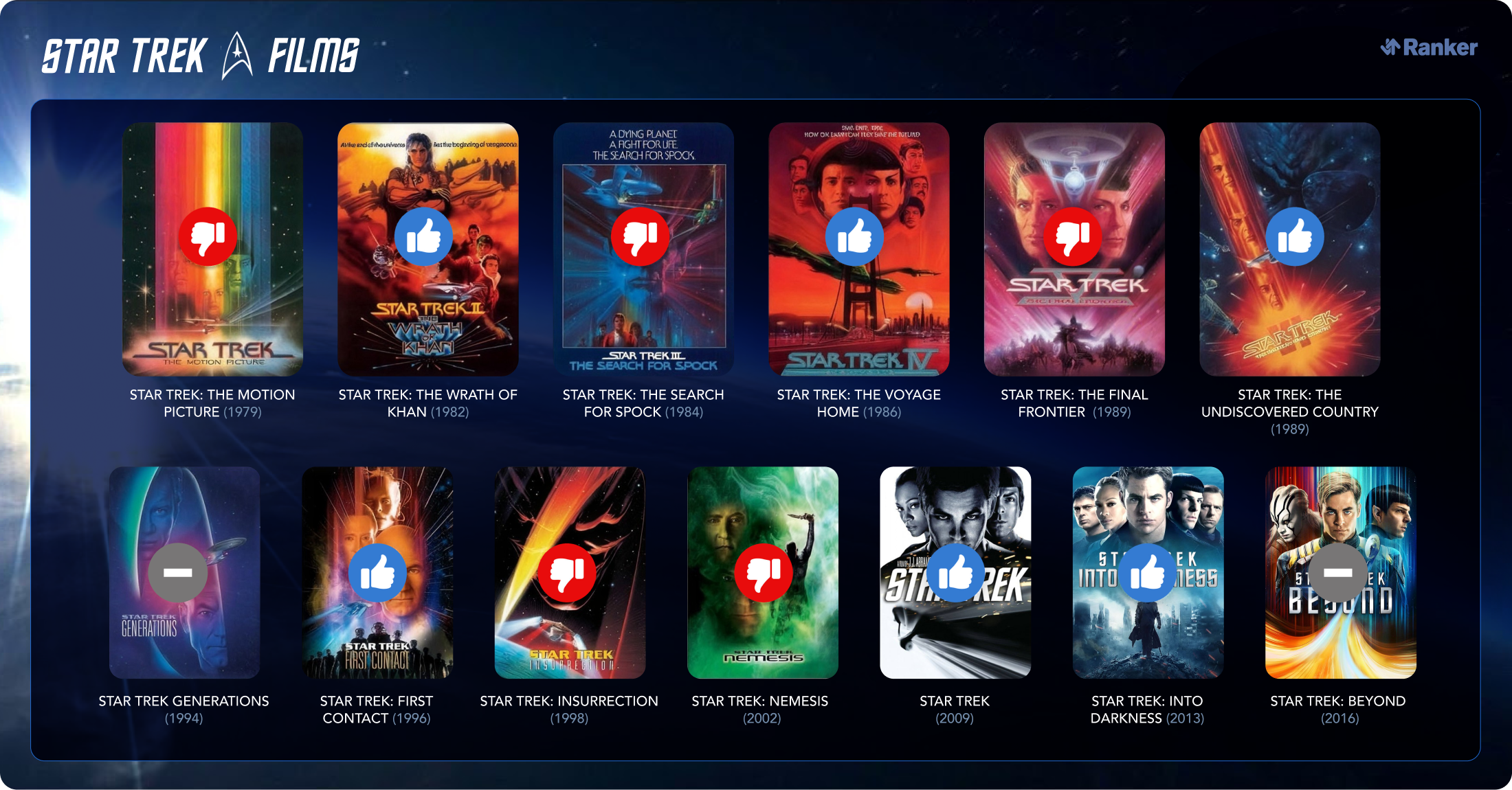
Star Trek Fan Rankings / Ranker.com
To fully grasp what resonates with the Star Trek audience, Ranker tracks audience sentiment on a +1 to -1 scale based on real viewer voting, leveraging our massive panel of human opinion-data. Similar to polling, higher margins reveal clear audience consensus (favorable or unfavorable), while scores hovering near zero signal divided audience opinion.
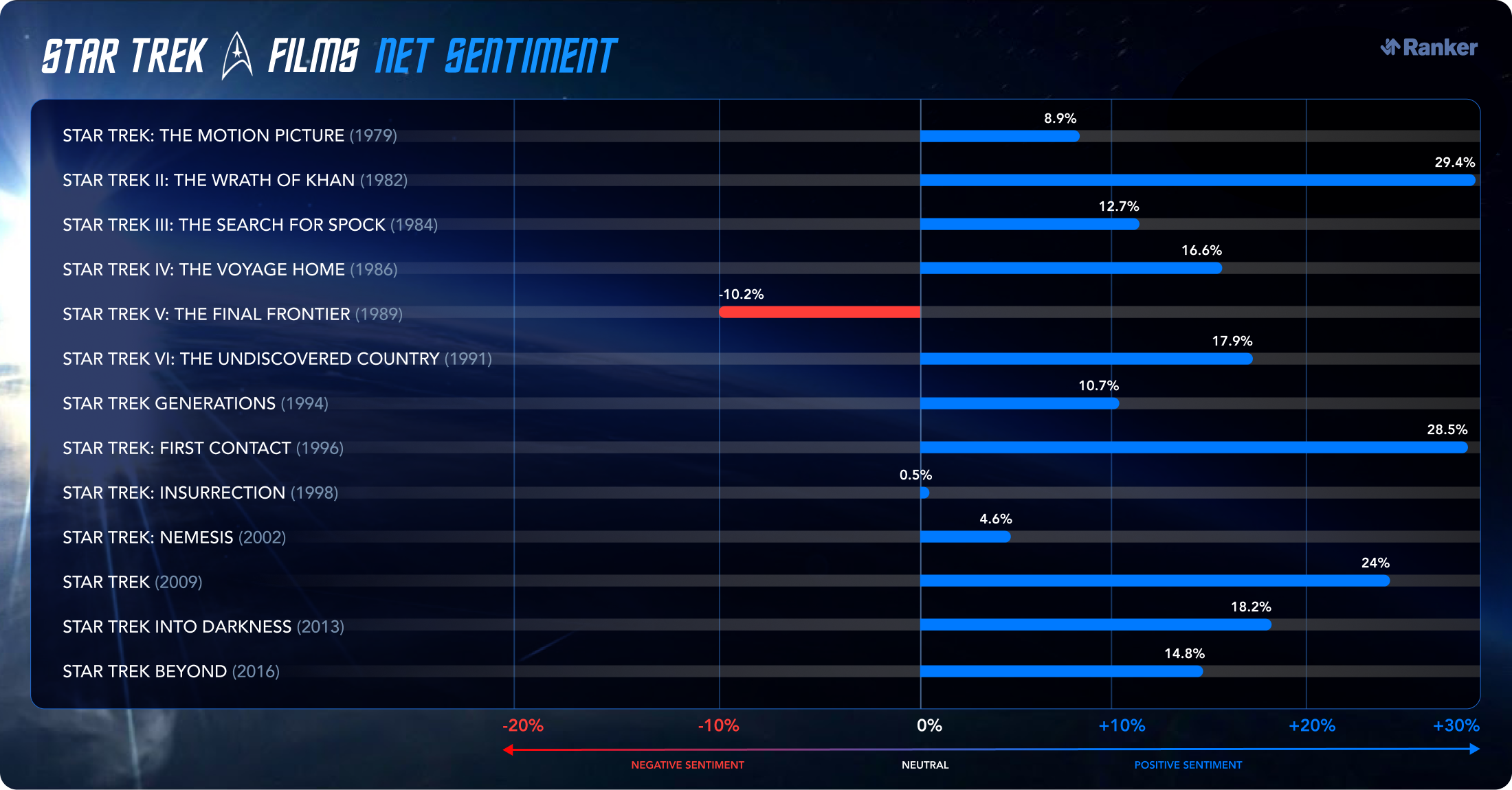
Star Trek Fan Rankings / Ranker.com
The data proves the even-numbered Star Trek movies are vastly superior to the odd ones. The Wrath of Khan tied for the highest sentiment of the classic era, while The Final Frontier (plagued by a messy, unfocused narrative) went down to an all-time low -10.3%. For marketers, this highlights a fanbase that is extremely loyal to high-stakes character conflict and top-tier storytelling, but very critical when it comes to tonal misinterpretations.
Star Trek: Nemesis (2002): It landed a 4.6% net sentiment. That might be the third lowest ranking on the list, but it’s still a surprising win compared to Star Trek: The Final Frontier, which fell to a hard -10.3%. This film is widely considered a low point for the franchise as it got rid of Star Trek's signature philosophical depth and instead replaced it with generic action.
First Contact matches The Wrath of Khan at 29.4% positive sentiment because it perfectly balanced high-concept sci-fi with cinematic action. However, the data trail went cold in 2002. Nemesis serves as a textbook "flop”. By stripping away Trek’s signature philosophical depth in favor of generic, early-2000s action tropes, it alienated the core fanbase so harshly that it stands as the structural low point of this particular Star Trek timeline.
Notice the remarkably steady, high-tier consistency here. J.J. Abrams’ alternate timeline managed to stabilize the franchise. By offering a fresh entry point that didn't require in-depth knowledge of the past 40 years, these films maintained a positive sentiment, proving that high-production value and dynamic pacing can successfully sustain a mainstream crossover audience.
On January 24, 2025, we were hit with Star Trek: Section 31 which takes the last place (14/14) on Every Star Trek Movie, Ranked Best to Worst. This is direct proof that attempting to go against the iconic Abrams era causes a greater dislike than favor. Similarly to Nemesis, the data shows that the modern Star Trek fans pushed back against a lack of the franchise’s optimism. Section 31 leaned into darker themes and complex plot mechanics, which our data shows that Trekkies are beginning to find oversaturated.
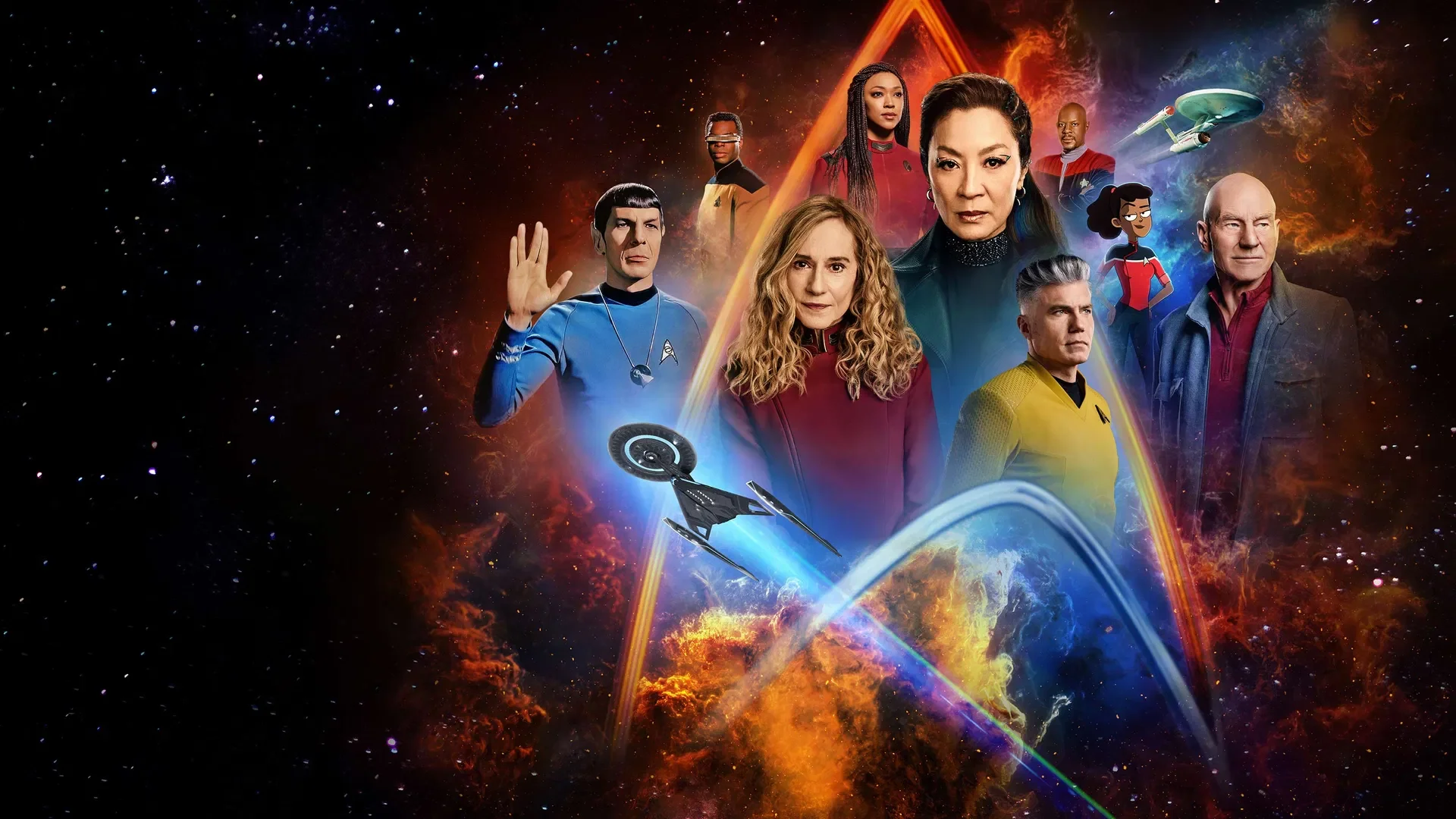
Star Trek: Section 31 / Paramount+ / Paramount Global
The Evolution of Trekkies: How Audiences Have Shifted Across Eras
To understand where Star Trek is going, we first have to look at where its core fan bases reside. Ranker data shows that the franchise’s long history is split into different generations, which are each defined by entirely different tastes.
The Legacy Generations:
Fans of the classic Kirk and Spock era hold a deep love for nostalgic, yet heroic 1980s pop culture. Our data shows that TOS fans are 2x more likely to enjoy the Back to the Future franchise and 4x more likely to be into retro hits like Superman I and Superman II.
On the other hand, voters who favor the peak 1990s syndicated era of Star Trek show an incredibly strong affinity for prestige mystery and paranormal procedurals. TNG and Deep Space Nine fans are 6x more likely to be into the drama series, Little House on the Prairie and 3x more likely to be into the drama Severance. However, when it comes to films these fans stay close to home. Being 5x more likely to indulge in Dune and 4x more likely to favor several different Star Wars films.
The Modern Era:
The modern era of Star Trek has attracted a younger, highly online audience that actively participates in contemporary geek culture. These fans view Star Trek as part of a massive pop-culture ecosystem. Our polling shows that these fans are 2x more likely to play gaming hits like The Last of Us and are heavily invested in the broader Marvel Cinematic Universe. As the data shows, these fans are expecting the serialized storytelling, witty characters and interconnected lore across a multiverse.
Its influence on science fiction is difficult to overstate. Star Trek helped define what thoughtful, idea-driven sci-fi could look like on television and film, blending adventure with philosophical and social commentary. Generations of creators, scientists, engineers, and filmmakers have cited it as an inspiration, and many conventions of modern science-fiction storytelling trace back to its innovations in worldbuilding, serialized universes, and ensemble casts.
By continually adapting to changing eras while preserving its central ideals, Star Trek remains culturally relevant and influential with each new installment, standing as one of the defining franchises in the history of popular culture.
Whether it’s aligning a streaming premiere with fans of premium political dramas or something else, understanding these psychographic crossovers ensures that Star Trek will continue to live long and prosper in a crowded entertainment landscape where they can attract new, younger audiences.
Target Smarter. Reach More Fans with Ranker.
These insights are powered by Ranker Insights, which transforms over 1.5 billion fan votes into actionable psychographics across numerous categories like movies, gaming and TV. As a comScore Top 50 Digital Media Property , Ranker offers a variety of ad solutions, from high-impact digital and social campaigns to syndicated and custom audiences available on major DSPs including The Trade Desk, Xandr, Lotame, TransUnion and MadHive. Whether you need to reach elusive streaming fans or push custom first-party segments to your DSP, our deterministic data ensures scalable, future-proof results.
To see how we can customize a strategy for your business, contact us at insights@ranker.com or visit business.ranker.com.